
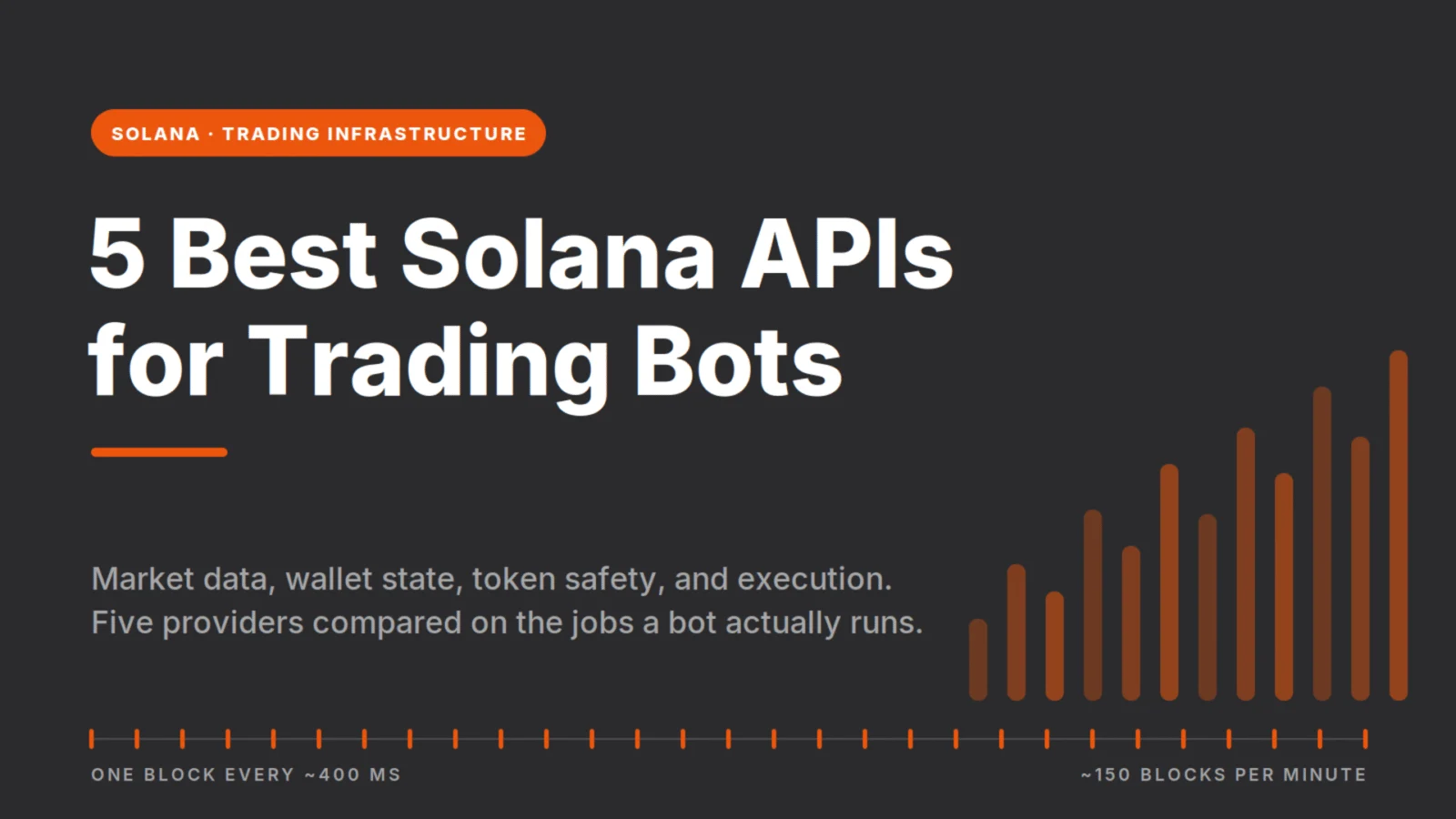
Solana generates a block roughly every 400 milliseconds. Algorithmic trading bots must keep pace, yet many fall behind directly at the data layer.
Because no single API handles every task, this guide examines five distinct providers. Each manages a specific component of a functional trading bot, highlighting the exact layer each one controls.
What Does a Solana API Actually Do?
A Solana API acts as the bridge between your trading script and the broader network, returning JSON responses to your code’s requests.
This straightforward description masks a notable division. While certain providers operate underlying nodes, others index and enrich the raw data those nodes produce, and a few focus entirely on trade execution rather than data retrieval.
This distinction is particularly critical on Solana. Raw account information is delivered base64-encoded via the standard JSON-RPC interface without accompanying prices or token metadata. Consequently, developers must either write custom parsers or utilize a provider that handles this preprocessing automatically.
Trading bots experience this friction immediately, as a trade signal loses its value if the corresponding account balance is outdated.
A similar division exists across the wider cryptocurrency ecosystem.
The Solana Trading Bot Stack
Five distinct layers comprise a complete trading bot stack, each answering a different operational question. No single vendor addresses all five requirements; most development teams begin with two layers and incorporate the remaining ones as operational demands increase. The ordered list below reflects each layer’s primary function.
How to Pick the Right One
Narrow down your options before diving into exhaustive feature comparisons.
Data freshness. Sniper bots demand sub-second data updates, whereas portfolio rebalancing bots can easily tolerate several seconds of latency.
Read or write. Data providers retrieve current network state, whereas execution providers transfer funds. Very few services excel at both.
Parsing burden. Determine which metrics arrive pre-priced; everything else translates into custom code you will have to maintain.
Pricing model. Billing structures vary widely, utilizing credits, request units, flat subscription tiers, or transaction tips.
AI compatibility. Model Context Protocol (MCP) support determines whether an autonomous agent can query your infrastructure stack directly.
With these evaluation filters established, here are five prominent Solana APIs worth deploying.
1. CoinStats API
CoinStats’ Solana API converts any Solana wallet into structured JSON data. By submitting an address, you retrieve associated SPL tokens, SOL balances, transaction history, and decentralized finance positions, with every asset automatically valued in USD.
Coverage extends across more than 120 blockchains utilizing a unified schema, enabling bots built on Solana to retain their core integration when expanding to new networks.
This infrastructure already supports one million monthly users. Its positioning is clear: it serves as a data API rather than an RPC node. A broader Solana API comparison outlines where each service category fits best.
For automated trading bots, the primary advantage is complete position awareness, as balances, active DeFi positions, and realized profit-and-loss metrics arrive fully parsed.
Key features
- Solana wallet data. Provides SPL token balances, SOL amounts, and comprehensive transaction logs, with swaps and program interactions automatically valued in USD at the time of execution.
- DeFi positions, auto-detected. Automatically identifies staking, lending, and liquidity pool positions across platforms like Marinade, Kamino, Orca, and Raydium without requiring individual protocol configurations.
- Portfolio analytics. Delivers total portfolio value, asset allocation, performance metrics, and both realized and unrealized PnL through a single endpoint.
- Market data. Supplies real-time pricing information for over 100,000 digital assets spanning more than 200 exchanges.
- CoinStats MCP Server. Integrates over 20 wallet and portfolio utilities behind a single OAuth URL, compatible with Claude, Cursor, Claude Code, VS Code, and N8N.
- Cross-chain by default. Supports more than 120 blockchains and 10,000 decentralized finance protocols under one consistent schema.
- Response times. Live API requests typically return data within 100 to 200 milliseconds.
Pricing
Operating on a credit-based model with an available free tier, CoinStats grants 20,000 free credits per month to support prototyping and lightweight production use. Credits scale according to the complexity of the requested endpoint rather than raw call volume.
Where it fits
Ideal for portfolio-aware trading strategies, dynamic position sizing, risk management logic, multi-wallet oversight, PnL tracking dashboards, and AI agents requiring deep wallet context.
Limitations
Because it offers no RPC node access or transaction broadcasting capabilities, this is a strictly read-only solution. Latency-sensitive sniper bots will still require a dedicated streaming layer alongside it.
2. Chainstack
Chainstack powers global blockchain applications for fintech enterprises, DeFi protocols, wallet providers, custodians, and analytics firms, delivering dependable and predictable RPC connectivity across more than 70 protocols, including Solana.
Node flexibility serves as its primary differentiator. Global Nodes automatically route every request to the closest healthy geographical region, while Dedicated Nodes operate on isolated infrastructure, with self-hosted deployment options also available.
For automated traders, real-time streaming holds more value than traditional polling. Yellowstone gRPC Geyser pushes structured account, transaction, and slot events instantly as they occur, entirely eliminating the need for polling loops.
Key features
- Nodes across 70+ protocols. Offers both managed and self-managed options, enabling a single vendor to support Solana alongside any future network expansions.
- Yellowstone gRPC streaming. Delivers structured Solana network events with significantly lower latency than conventional RPC polling, with pricing starting at $49 per month for a single stream.
- Global Nodes. Features geographically balanced endpoints equipped with automated request routing and failover mechanisms.
- Archive data, debug, and trace. Accessible on paid subscription tiers, with Solana historical archive access starting at $49 monthly.
- Official MCP server. Allows developers to deploy nodes and query blockchain data directly from Claude, Cursor, and other agent-based clients.
- Compliance posture. Certified under SOC 2 Type II and ISO 27001 standards, featuring single sign-on (SSO) and role-based access control.
- Crypto billing. Supports payments made in SOL or over 150 alternative digital tokens.
Pricing
The free Developer plan includes 3 million request units per month at a rate of up to 25 requests per second (RPS). Growth tiers start at $49 per month, where standard node calls consume one request unit and archive queries cost two.
Where it fits
Suited for bots requiring reliable read capabilities, transaction submission channels, and real-time event streaming, as well as engineering teams launching across multiple blockchain networks simultaneously.
Limitations
The free tier is restricted to very light usage. Teams should verify archive and regional options for their specific workloads before committing. Because nodes return raw, unparsed data, price calculations and portfolio logic must be handled elsewhere.
3. Codex
Codex delivers heavily enriched Solana blockchain data without requiring complex RPC parsing. It provides immediate access to real-time USD pricing, OHLCV charts, holder analytics, and aggregated volume statistics.
Performance is a major highlight, maintaining data freshness at a one-second interval alongside WebSocket subscriptions that ensure 99.9% uptime for live feeds. The platform also tracks newly launched tokens across Pump.fun and other popular launchpads.
With coverage spanning over 80 networks, Solana-centric trading bots can expand to new ecosystems without switching providers, integrating easily via GraphQL.
Key features
- Real-time token prices. Delivers accurate USD valuations across more than 90 million tokens with one-second freshness.
- OHLCV charts. Provides ready-to-use candlestick data tailored for strategy backtesting and signal generation.
- Holder analytics. Tracks holder counts, token distribution metrics, and individual wallet activity per asset.
- Launchpad tracking. Automatically surfaces brand-new Solana token launches the moment they appear.
- WebSockets and webhooks. Streams live pricing and trade execution data straight to your trading bot.
- GraphQL and SDK. Offers a TypeScript SDK via @codex-data/sdk alongside an MCP server designed for autonomous agents.
- Production track record. Powers prominent platforms including TradingView, Coinbase, MoonPay, Uniswap, and Pump.fun.
Pricing
A free tier supports up to 10,000 requests per month with complete query access, while Growth tiers begin at $350 per month, adding direct WebSockets and webhook support.
Where it fits
Ideal for signal generation engines, market screeners, launch trackers, and any trading bot driven by price action, trading volume, or holder wallet flows.
Limitations
Its scope is limited strictly to on-chain decentralized exchange (DEX) token data. Centralized exchange balances are omitted, as are decoded DeFi positions such as staked assets or liquidity pool tokens, requiring a complementary portfolio layer to bridge the gap.
4. Jito
Jito functions as the primary Maximal Extractable Value (MEV) infrastructure layer utilized by most Solana trading bots for transaction submission. Its Block Engine executes an off-chain auction where winning transaction bundles are forwarded directly to the next block leader.
Transaction bundles are the primary reason developers utilize this service, allowing up to five transactions to execute atomically, ordered sequentially by the attached tip size. If any single transaction in the bundle fails, none of them are processed, effectively eliminating an entire category of execution bugs by ensuring a token swap and its protective guard transaction land together or not at all.
Key features
- Bundles. Combines up to five transactions for atomic execution with integrated revert protection.
- Block Engine auction. Uses priority tips to determine execution order, securing winning bundle placement in the upcoming leader’s block.
- Transaction and bundle APIs. Supports standard JSON-RPC methods including sendTransaction, sendBundle, getBundleStatuses, and getTipAccounts.
- Live tip pricing. Publishes current tip benchmarks via a dedicated REST endpoint and WebSocket data stream.
- Sandwich mitigation. Provides documented protections for transactions routed through the engine.
- Official SDKs. Supplies official client libraries written in TypeScript, Python, Rust, and Go.
- No subscription. Operates without subscription fees under published rate limits, with higher tiers available upon request.
Pricing
Submission is entirely free of subscription fees; your costs consist solely of the competitive tip you bid alongside standard Solana network fees. Because tip requirements fluctuate dynamically with network demand, developers should monitor the tip stream before calculating bid sizes.
Where it fits-2
Essential for sniper bots, arbitrage systems, liquidation engines, and Telegram-based trading bots—any strategy where securing inclusion within a precise block determines whether the trade succeeds.
Limitations
Jito is purely execution infrastructure rather than a data source, meaning it provides no prices, account balances, or historical logs. Additionally, Jito retires its ShredStream service on September 5, 2026, requiring dependent streaming architectures to integrate an alternative provider.
5. DFlow
DFlow bridges the critical gap between generating a trading signal and executing a filled order, offering an API that quotes any SPL token across aggregated Solana liquidity pools without deducting internal protocol fees.
Two distinct operational modes accommodate different trading requirements: imperative swaps grant complete route control at the exact moment of signing, whereas declarative swaps trade that routing control for reduced slippage and enhanced sandwich protection.
Liquidity is pooled from on-chain AMMs, professional market-maker (Prop AMM) networks, and order-book venues, integrating platforms like Raydium, Orca, Meteora, and Pump.fun behind a single unified execution interface.
Key features
- Trading API. Enables developers to fetch quotes, sign transactions, and submit token swaps through a streamlined interface.
- Two swap modes. Allows a choice between imperative mode for direct route control and declarative mode for minimized slippage and anti-sandwich protection.
- JIT routing. Re-optimizes execution directly on-chain rather than relying solely on the original quote conditions.
- Order book streams. Supplies WebSocket feeds providing real-time pricing quotes and ten levels of market depth.
- Sponsored swaps. Permits third-party sponsors to cover gas fees, allowing end users to execute trades gaslessly.
- Agent tooling. Includes an interactive Agent CLI capable of executing trades, integrated Claude Code skills, and an MCP server documenting specifications and APIs.
- Signed responses. Provides cryptographic signatures on API responses upon request.
Pricing
Developer endpoints are fully accessible without requiring an API key, subject to published rate limits. Production keys offer expanded thresholds and are granted upon request, with approval turnarounds taking between two and five days.
Where it fits
Designed for trading bots focused on active execution rather than passive observation, including custom swap interfaces, copy-trading systems, and AI agents equipped with wallet permissions.
Limitations
Restricted exclusively to the Solana network with no multi-chain capabilities. Securing production access requires an approved key, necessitating careful planning around the review period. Furthermore, market data endpoints focus primarily on real-time quotes and book depth rather than historical analytics.
How One Trade Moves Through the Stack
Executing a single trade signal requires sequential interaction with five separate providers: a streaming layer detects the event, market data prices the asset, wallet data sizes the position correctly, and routing combined with block inclusion infrastructure places the transaction on-chain.
Omitting any single layer forces the trading bot to operate on outdated state data—which is historically the primary cause of trading losses rather than flaws in the underlying strategy.
At a Glance
| Provider | Layer | Solana coverage | MCP Server | Free tier |
| CoinStats API | Wallet, DeFi, portfolio, market data | 120+ chains, 10,000+ DeFi protocols | Yes | 20,000 credits/month |
| Chainstack | RPC nodes and gRPC streaming | 70+ protocols, mainnet and testnet | Yes | 3M request units/month |
| Codex | Token prices, OHLCV, holders | 90M+ tokens, 80+ networks | Yes | 10K requests/month |
| Jito | Bundles and block inclusion | Solana only | No | No subscription, tips only |
| DFlow | Quotes and trade execution | Solana only | Docs only | Keyless developer endpoints |
Picking the Right Provider
No single provider can support a Solana trading bot entirely on its own; most production-grade systems integrate three or four of these services simultaneously.
For managing wallet balances, DeFi integrations, and portfolio state, the CoinStats Solana API offers the most comprehensive starting point, handling the read side via a single REST API and MCP Server.
To secure robust node access and real-time event streaming, Chainstack manages the underlying infrastructure layer across more than 70 protocols.
For tracking token prices, candlestick charts, and holder dynamics, Codex provides the essential signal data.
When the goal is guaranteeing trade inclusion within a precise block, Jito bundles effectively eliminate order-manipulation risks.
To handle trade quoting and optimal route execution, DFlow manages the final transaction path.
Always build your infrastructure around your bot’s specific operational demands rather than pricing pages, as the architectural layer you choose to skip is typically the one that fails first.
The post 5 Best Solana APIs for Algorithmic Trading Bots in 2026 appeared first on The Coin Republic.